July–August 2026 Genealogy Spotlight
Virginia Caroline Pauldino Chance: A Life Beyond the Headlines
Fashion, a contested inheritance, and the tragedy that did not define her
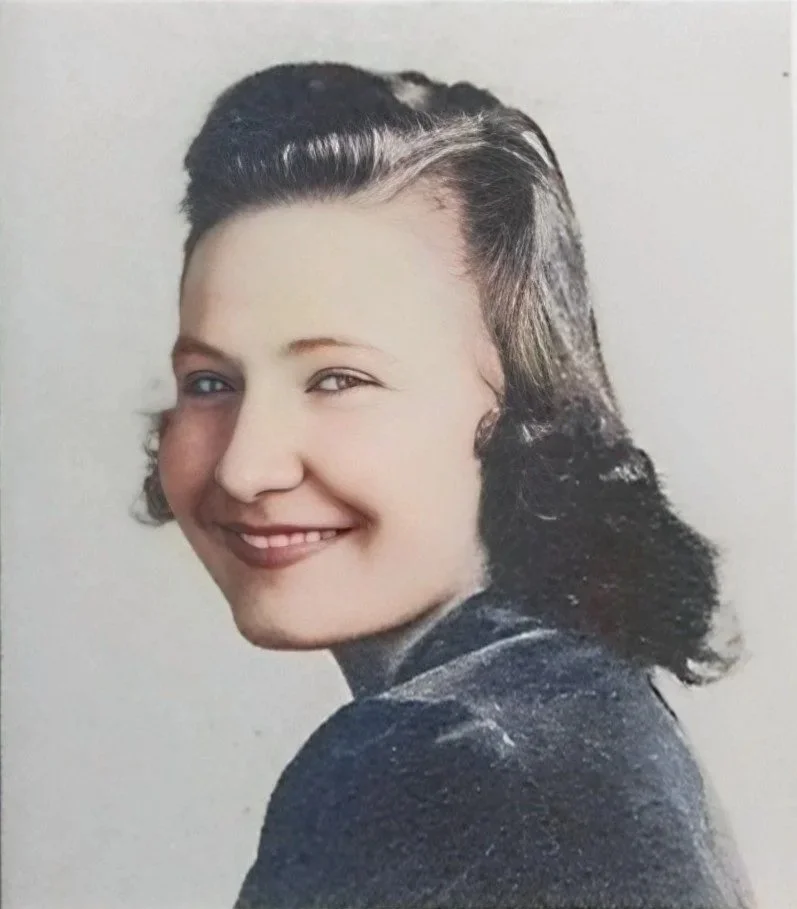
Virginia Pauldino in her 1941 North High School yearbook portrait.
Source: North High School, 1941 yearbook; “U.S., School Yearbooks, 1880–2012,” Ancestry.com, accessed July 2026.
Until recently, Virginia Caroline Pauldino Chance was little more than a name in my family tree.
I never had the opportunity to know my cousin Virginia, and she never knew me. There are no shared memories between us, no family conversations I can call on, and no stories I heard directly from her.
What brought her closer were the traces she left behind: a smiling yearbook photograph, courtroom coverage, fashion announcements, and newspaper reports from the final and most tragic chapter of her life.
At first, those pieces seemed to belong to different women.
One was a young woman smiling for her high school yearbook. Another appeared in court wearing furs and diamonds. A few years later, she was directing fashion shows in Malibu. Then came the headlines describing a house as a "fortress" and reporting the violent deaths of Virginia and the man newspapers identified as her husband.
The more I uncovered, the more certain I became that her life could never be captured by a single article.
It is a life reconstructed from surviving records—records that sometimes conflict, leave questions unanswered, and reflect the sensational language of their time.
Even so, taken together they allow us to see more of the woman behind the headlines.
A Promise and a Public Court Battle
In January 1957, Virginia’s name appeared prominently in the Los Angeles Examiner.
She was twenty-eight years old and seeking $500,000 from the estate of Frank S. Hofues, a wealthy hotel and club operator who had died the previous December.
Virginia claimed that she had been Hofues’s common-law wife and that he had signed a codicil, an addition to his will, leaving her $500,000 in twenty annual payments of $25,000.
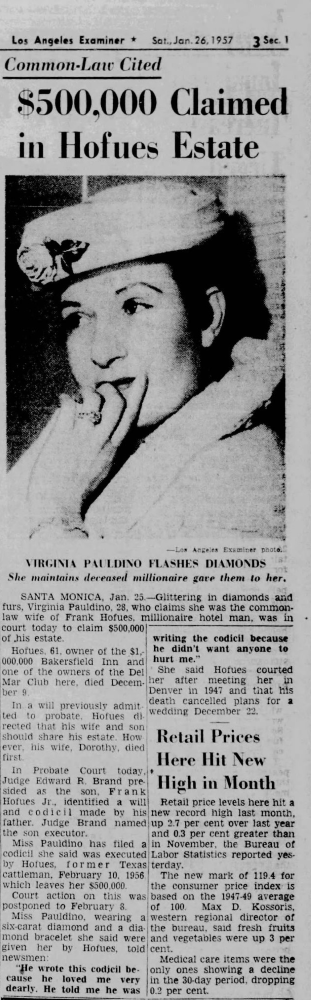
Virginia Pauldino appeared in probate court seeking $500,000 from the estate of hotel operator Frank S. Hofues. She said the diamond ring and bracelet she wore had been gifts from Hofues.
Source: “Common-Law Cited: $500,000 Claimed in Hofues Estate,” Los Angeles Examiner, January 26, 1957, Section 1, p. 3.
The newspaper photographed Virginia wearing a fur hat, a six-carat diamond ring, and a diamond bracelet. She maintained that Hofues had given her the jewelry.
The image was glamorous, and the headline was designed to attract attention. Beneath it, however, was a complicated legal and deeply personal story.
Virginia said she had met Hofues in Denver in 1947. In later testimony, she claimed they had gone through a marriage ceremony there on August 19, 1949, and had lived together as husband and wife until his death.
She also acknowledged learning that Hofues had a wife living in Texas. Other reports stated that his wife, Dorothy, died before he did.
According to Virginia, Hofues wrote the codicil because he loved her and wanted to provide for her financially. She also testified that they had planned to marry formally in December 1956, but Hofues died before the wedding could take place.
The estate disputed her account.
What followed was more than a disagreement over money. It became a public examination of a private relationship, with attorneys and witnesses offering sharply different versions of what had happened between Virginia and Hofues.
Conflicting Stories in Court
By June 1958, the case was still being fought.
One report described two competing claims to Hofues's estate: Virginia's claim under the $500,000 codicil and another brought on behalf of Hofues's son and heir.
Virginia appeared in court with her sister, Antoinette Urbaitis, beside her.
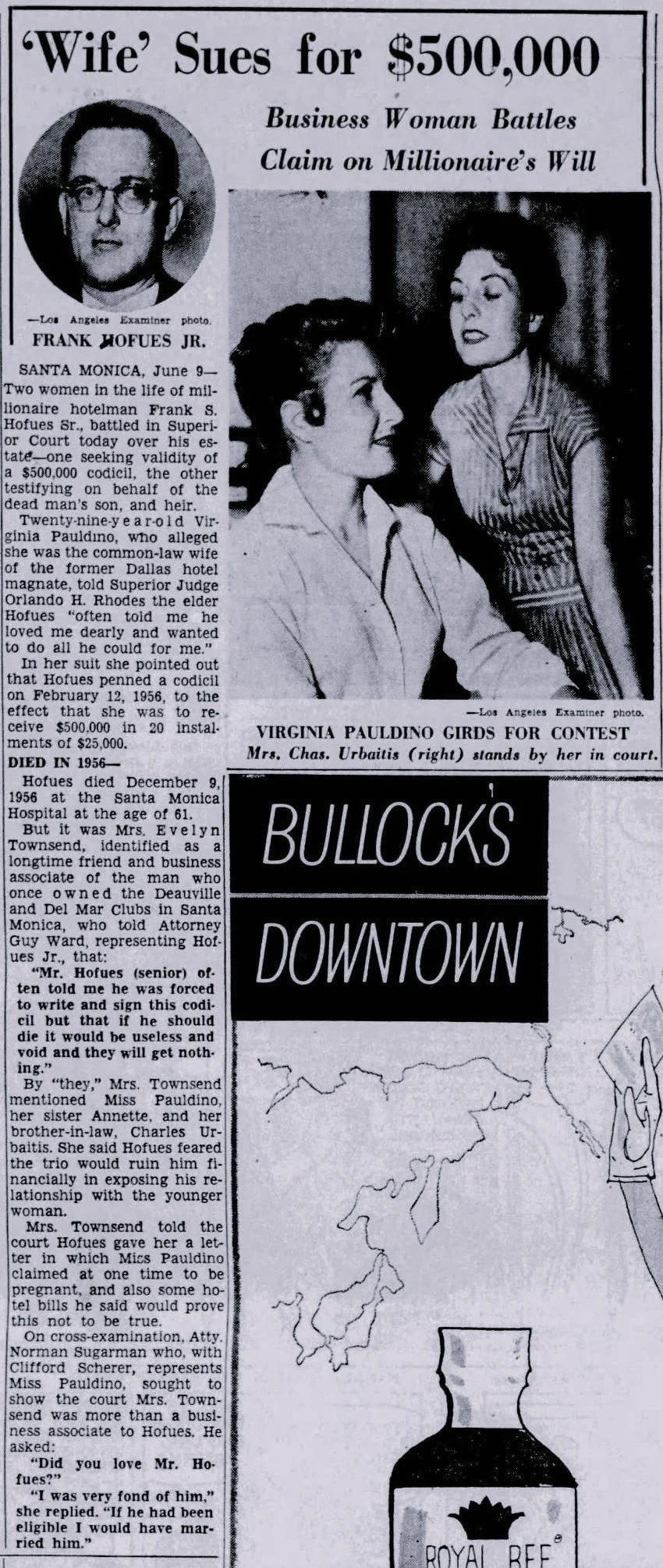
Virginia Pauldino, seated, confers with her sister, Antoinette Urbaitis, during the court battle over a disputed $500,000 codicil in the estate of Frank S. Hofues.
Source: “‘Wife’ Sues for $500,000,” Los Angeles Examiner, June 10, 1958, page number not visible in the surviving clipping.
A longtime friend and business associate of Hofues testified that he had felt pressured into signing the codicil and feared his relationship with Virginia could ruin him financially.
Those were allegations made during a contested estate proceeding. They were not neutral or uncontested descriptions of Virginia, and I do not present them as established facts.
Virginia continued to defend her position.
During questioning, she was asked whether she had loved Hofues. Her response was more complicated than the newspaper's repeated description of her as his "wife" or "common-law wife."
She said:
"I was very fond of him. If he had been eligible I would have married him."
That statement does not provide an easy answer about their relationship. Neither do the surviving newspaper accounts.
Virginia described a marriage ceremony and years of living together, yet she also acknowledged that Hofues had not been legally free to marry her at the beginning of their relationship. The estate denied her account, and I have not found a court decision formally declaring her to be Hofues's legal wife.
The most accurate way to describe this chapter is that Virginia claimed she and Hofues had shared a marital relationship and fought to enforce a financial promise she believed he had made to her.
The Pauldino Fashionettes
The next newspaper accounts reveal a very different side of Virginia.
In June 1961, she appeared in the entertainment and society pages as the director of the Pauldino Fashionettes.
A fashion luncheon was planned for the Garden Room at the Trancas Restaurant in Malibu. The show featured bathing suits, capri outfits, cottons, silks, and Italian fashions.
Virginia was not simply one of the women modeling the clothing. The announcement stated that the event was being held under her direction.
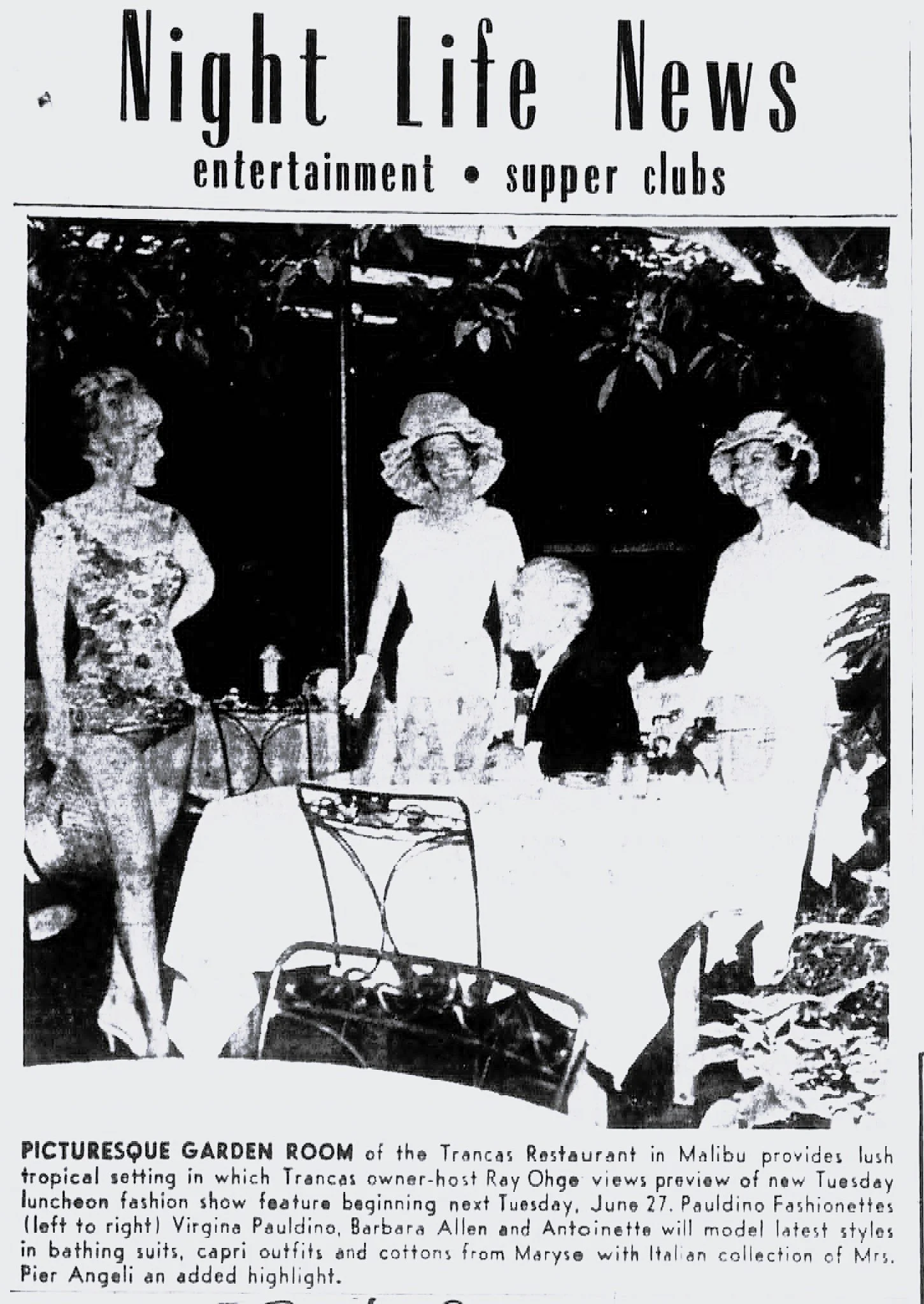
Virginia Pauldino, left, with Barbara Allen and Virginia’s sister Antoinette during a preview of the Pauldino Fashionettes’ luncheon show at the Trancas Restaurant in Malibu.
Source: “Night Life News,” Independent, June 22, 1961, p. 25.
The photograph captures something the courtroom articles never could.
Virginia is standing with her sister and another model in the restaurant's tropical Garden Room. She looks poised and confident, taking part in an event she helped organize.
That is one of the reasons I wanted to tell more than the most sensational parts of her story.
Here, Virginia is not being questioned about a millionaire's estate. She is not the subject of a crime report. She is simply a woman taking part in the social and creative life of Malibu in the early 1960s.
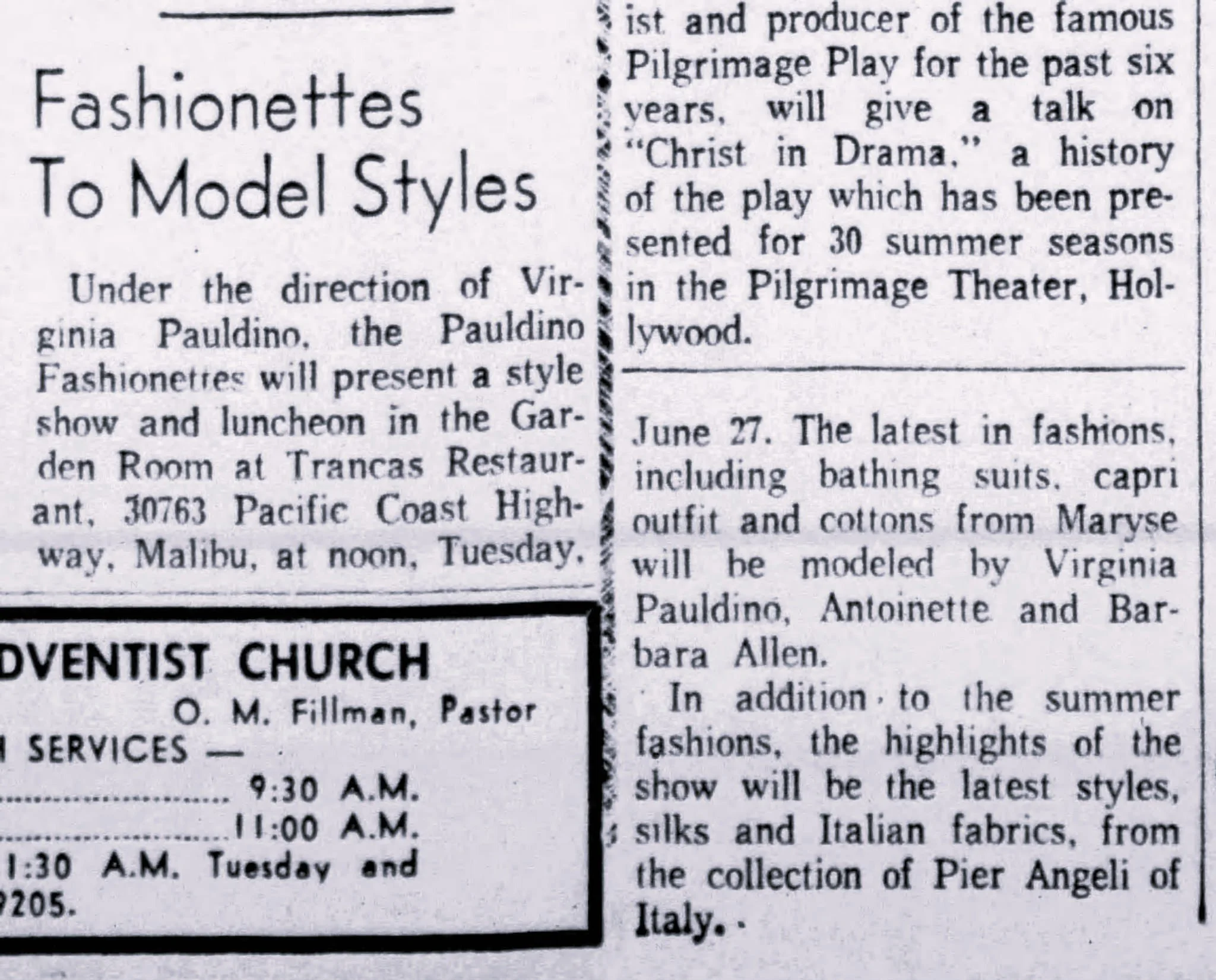
A newspaper announcement promoted the Pauldino Fashionettes’ June 27 luncheon and style show at the Trancas Restaurant in Malibu. The event was directed by Virginia Pauldino, who modeled alongside Antoinette and Barbara Allen.
Source: “Fashionettes to Model Styles,” Evening Vanguard, June 23, 1961, p. 4.
The announcement reveals something the photograph alone cannot.
Virginia was not simply standing in front of a camera. She was directing the event.
That brief description—“under the direction of Virginia Pauldino”—shows that she was doing more than modeling. She was organizing and leading the event, a side of her that newspaper stories about lawsuits and crime rarely captured.
How the Hofues Dispute Ended
The legal fight over the Hofues estate did not end when Virginia entered the Malibu fashion scene.
A newspaper report published in January 1963 finally filled in an important part of the story.
Virginia's original $500,000 claim had been settled for $150,000. By the time of the later proceeding, she had received $10,000 and was seeking payment of the remaining $140,000.

A later court proceeding revealed that Virginia Pauldino’s original $500,000 claim against the Hofues estate had been compromised for $150,000. At the time, she had received $10,000 and was seeking payment of the remaining balance.
Source: Howard Kennedy, “Bayley Gets Legal Control of ‘Haciendas,’” Los Angeles Times, January 24, 1963, p. 49.
The unpaid portion of Virginia's settlement became entangled in a financial proceeding involving the Hacienda hotel properties.
She objected to an arrangement that would have paid part of what she was owed in company stock. Virginia believed the stock was worthless and wanted the remaining balance paid in cash.
The article reported that she later withdrew her objections as part of the larger proceeding.
The compromise does not necessarily mean a court formally recognized Virginia as Hofues's wife. Estates sometimes settle disputed claims to avoid the cost, uncertainty, and delay of continued litigation.
What it does show is that Virginia did not simply disappear after the dramatic 1957 headlines. She continued pursuing her claim for years and eventually reached a negotiated settlement.
Virginia and Herbert Edwin Chance
By the 1970s, newspapers identified Virginia as Virginia Caroline Chance, the wife of Herbert Edwin Chance.
Herbert owned the Nu Way Lounge in West Los Angeles. Newspaper accounts consistently described Virginia and Herbert as husband and wife and referred to them together as "the Chances."
I have not found a civil marriage record for them.
That absence does not prove they were unmarried. They may have married in a place or at a time that does not appear in the available records. It is also possible that they lived publicly as husband and wife without a formally recorded marriage.
For that reason, I do not describe their relationship as a common-law marriage, nor do I claim to have confirmed a licensed marriage.
The most accurate description is simply this:
Contemporary newspapers consistently identified Herbert Edwin Chance as Virginia's husband, although I have not yet located a marriage record for them.
Herbert's grave marker raises another unanswered question. He was buried with his parents, William L. and Esther M. Chance, rather than beside Virginia.
That is interesting, but it does not determine their marital status. Burial arrangements can reflect family plots, ownership of cemetery spaces, personal wishes, relatives' decisions, or circumstances that were never recorded.
Why Virginia and Herbert were buried separately remains unknown.
The House Newspapers Called a “Fortress”
In October 1975, the story of Virginia and Herbert took a devastating turn.
They were found murdered inside their home in Venice, California.
Newspapers described the house as a "fortress" because it had barred windows, an alarm system, a heavy steel door, double locks, and an iron gate.
There were no obvious signs of forced entry. The iron gate, which was usually kept locked, had been found ajar.
A neighbor who had known Virginia for about fifteen years described her as "a very cautious lady." She said Virginia would never open the door to someone she did not know and could see visitors through a window before deciding whether to let them inside.
That detail led investigators to consider the possibility that Virginia and Herbert knew the person who entered their home.
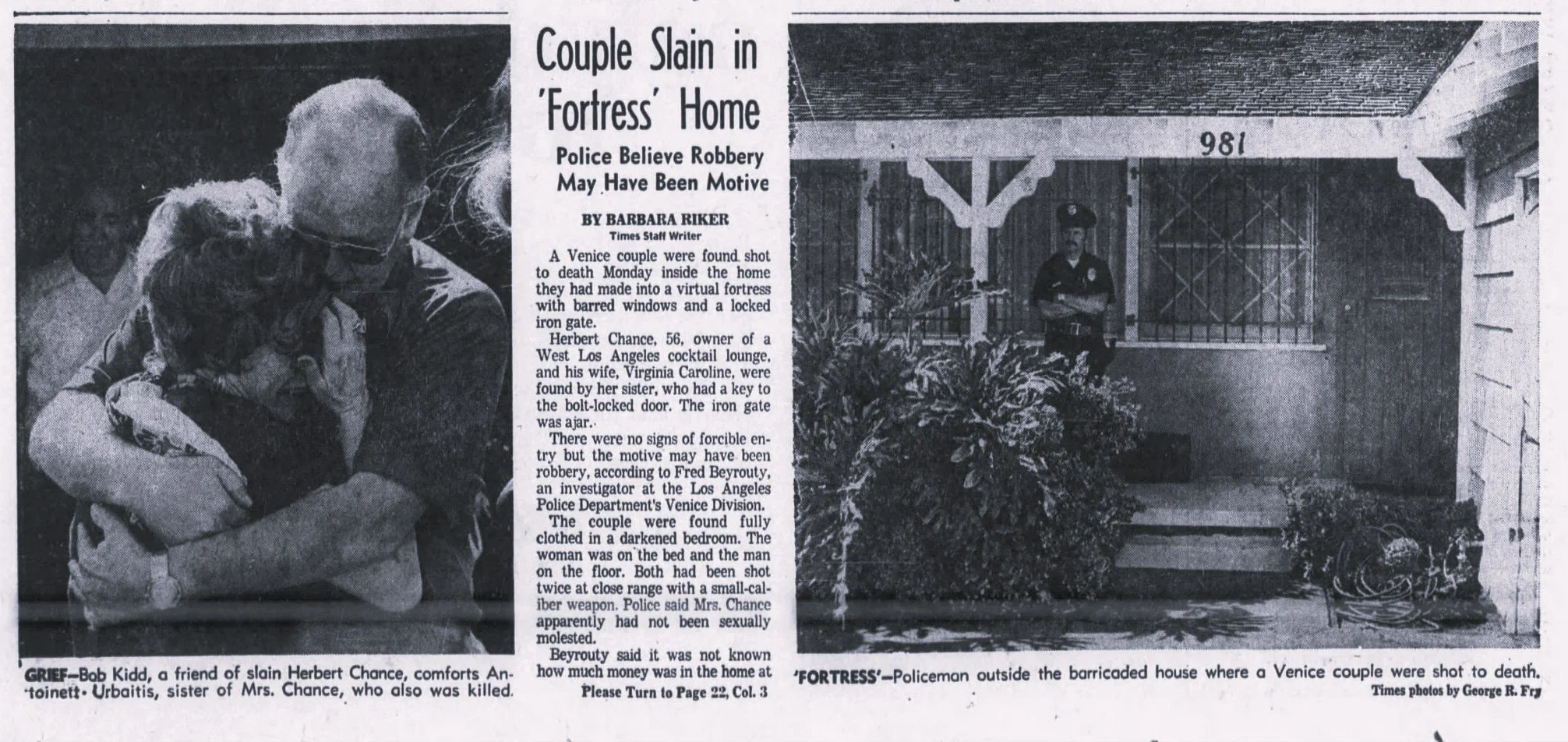
Police outside the Venice home where Virginia Caroline and Herbert Chance were found murdered in October 1975. At left, family friend Bob Kidd comforts Virginia’s sister, Antoinette Urbaitis.
Source: Barbara Riker, “Couple Slain in ‘Fortress’ Home,” Los Angeles Times, October 14, 1975, pp. 3 and 22. Photographs by George R. Fry.
The first newspaper stories appeared before police had a clear picture of what had happened.
A 1973 Mercedes was missing, and early reports gave conflicting estimates of how much money had been taken from the house. Some suggested that the violence may have grown out of an argument between Herbert and another man over a business venture.
Then the case widened.
Police connected the deaths of Virginia and Herbert to the murder of Dolores Watson, a waitress at Herbert’s Nu Way Lounge. Dolores was found in a parked car shortly after the Chances were discovered. She, too, had been shot.
As more evidence came to light, the early theories began to fall away. The later court proceedings revealed something far more calculated: a plan involving Herbert’s kidnapping and the robbery of the Chance home.
The Verdict
The case eventually brought George Patrick McKinney and Jerald Dee Sartain into the courtroom.
Sartain admitted killing Dolores Watson and became an important witness for the prosecution. He also testified about his part in Herbert’s kidnapping and the robbery of the house.
In February 1977, after a lengthy trial and sixteen days of jury deliberations, McKinney was convicted of murdering Herbert and Virginia.
Approximately $63,000 had been taken from their home.
The jury did not reach a verdict on the separate charge involving McKinney and the murder of Dolores Watson.
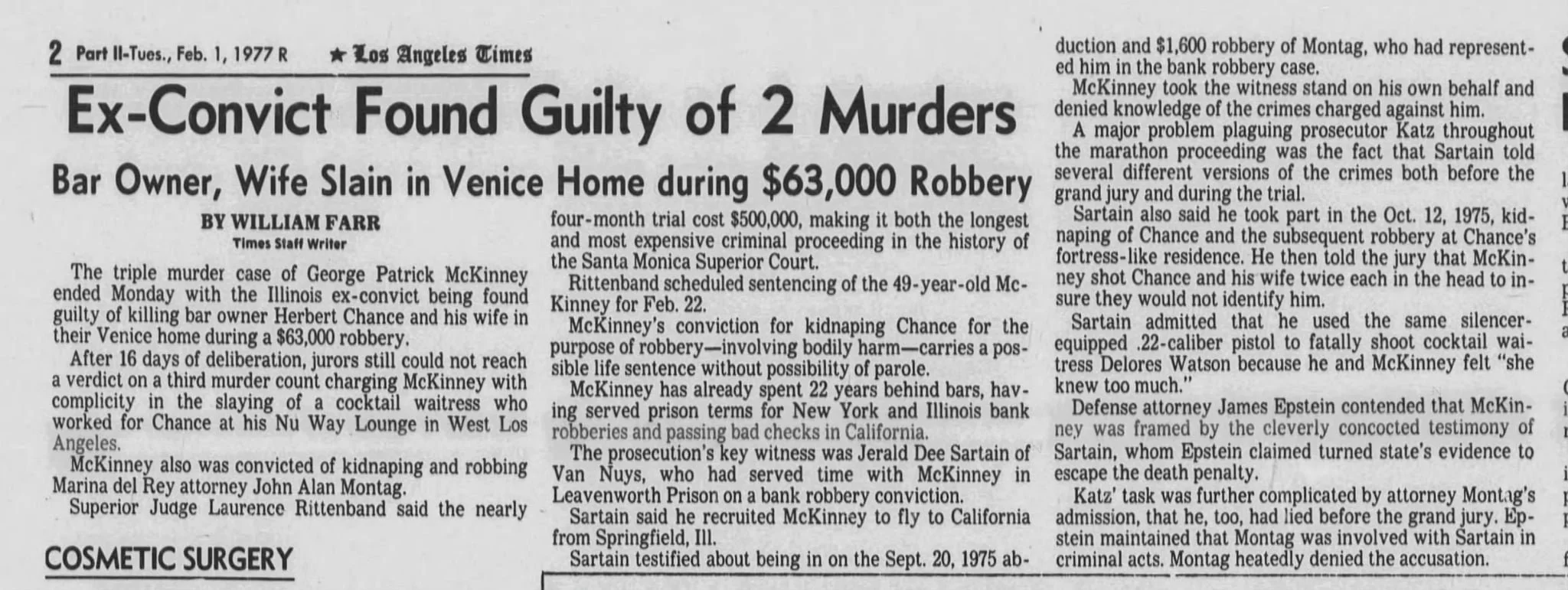
The Los Angeles Times reported that George Patrick McKinney had been convicted of murdering Herbert and Virginia Chance during the robbery of their Venice home. The jury did not reach a verdict on the separate murder charge involving Dolores Watson.
Source: William Farr, “Ex-Convict Found Guilty of 2 Murders,” Los Angeles Times, February 1, 1977, Part II, p. 2.
Remembering Virginia
I never sat across from Virginia.
I was twenty years old when she was murdered, but at the time, I knew nothing about her—or about that part of my family. As a late-discovery Black Market Baby, I did not learn the truth about my origins until many years later. By then, any chance of knowing Virginia was gone.
I never heard her voice, asked her about her life, or listened to her tell these stories in her own words.
Everything I know about her has been pieced together from what others left behind—newspaper articles, court proceedings, photographs, and family research.
The surviving record is incomplete. Some accounts contradict one another. Some contain accusations that were never proven. Others were written before investigators or juries had established what had happened.
The newspapers often defined Virginia by the men and events surrounding her.
Depending on the headline, she was the millionaire’s alleged common-law wife, the woman in furs and diamonds, the bar owner’s wife, or the victim inside the “fortress” home.
But she was more than any of those descriptions.
She was once the smiling girl in a 1941 yearbook.
She was a woman who stood in court and defended what she believed had been promised to her.
She was a fashion director standing beside her sister in a Malibu restaurant.
She was my cousin—a woman I never knew, but whose life slowly came back into view as I followed the records.
I cannot hear Virginia tell her story in her own words.
But I can make sure the last headline is not the only one attached to her name.
In my family history, Virginia Caroline Pauldino Chance will be remembered not only for the terrible way her life ended, but for the determined, resourceful, and vibrant woman she appears to have been.
Virginia and I never knew one another.
Through this research, I have come to know something of her journey and the place she holds in our family’s story.
That is where remembrance begins.
Research Note
Virginia appears in surviving records and newspaper coverage under several names:
Virginia Pauldino
Virginia Pauldino Hofues
Virginia Caroline Chance
Caroline Chance
Newspaper references to Virginia as Frank S. Hofues’s “wife” or “common-law wife” reflect her claim and the language reporters used at the time. I have not found a court ruling confirming that their relationship was legally recognized as a marriage.
Later newspaper reports consistently identify Herbert Edwin Chance as Virginia’s husband. I have not yet located a marriage record for them. Herbert was buried in his parents’ family plot rather than with Virginia, but the reason for their separate burial arrangements remains unknown.
These unanswered questions are part of the research. I will update this page if additional records are found.